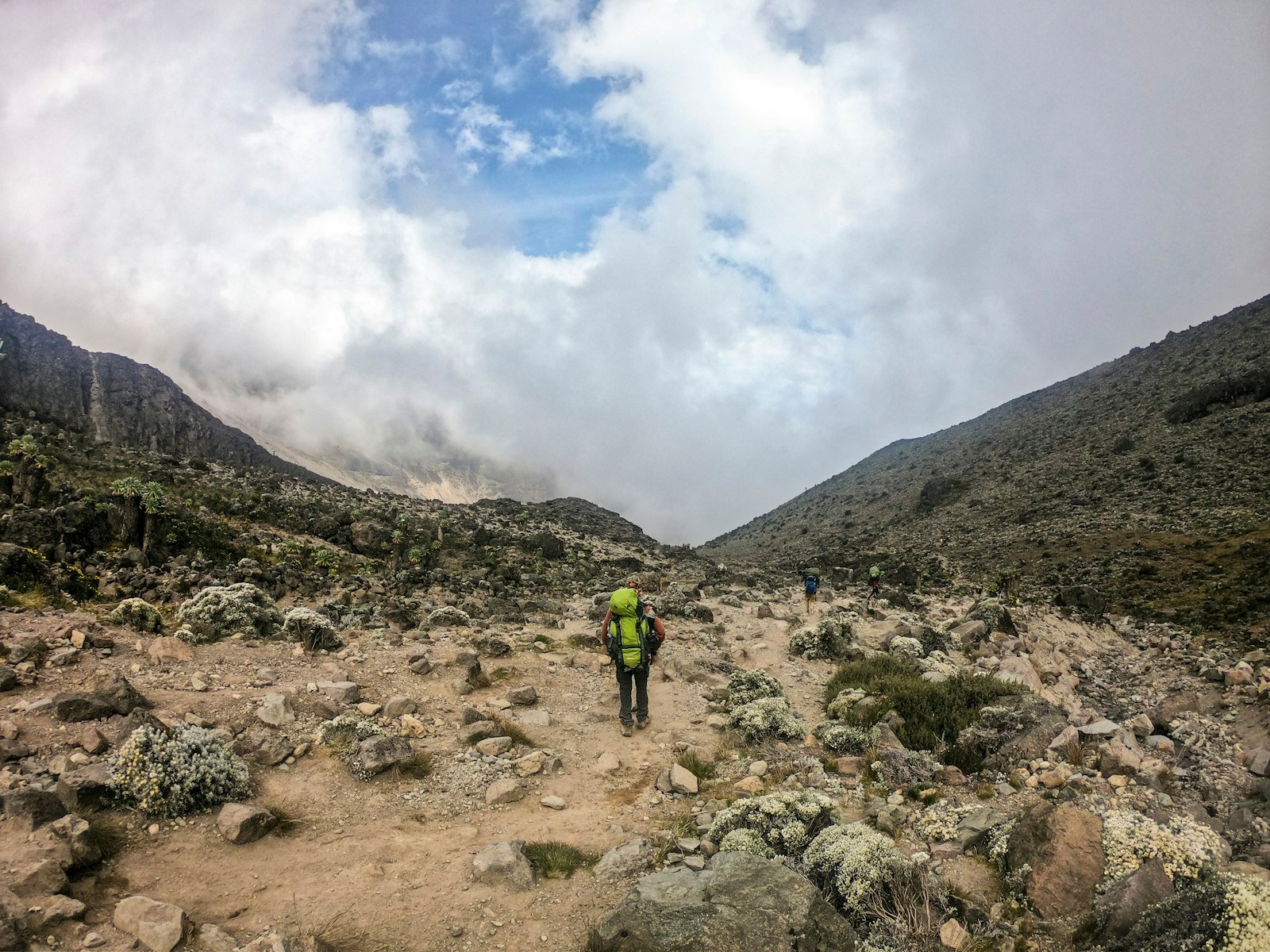
The longest Kilimanjaro route, with the highest reported summit success rates.
A full circle around the mountain, with views that other routes never show.
Very quiet trails on the north and east sides.
Overview
The Northern Circuit approaches from the west, curves around the north of the mountain and comes up to the summit from the east. It takes nine days, which gives your body plenty of time to adapt.
It is the best choice if you want to give yourself every chance of reaching the top and see parts of the mountain few others do. Compare it with the Lemosho route.
Tour facts
Difficulty
Challenging
Group sizes
Private, Small group
Great for
12+
Languages
English, Swahili
Start point
Moshi
Guest rating
4.8 / 5
Best months to travel
JanFebMarAprMayJunJulAugSepOctNovDec
Day-by-day itinerary
Day1Londorossi Gate to Mti MkubwaMount Kilimanjaro
We drive to Londorossi Gate to register, then to the trailhead and walk through rainforest to Mti Mkubwa camp at about 2,800 metres.
Day2Mti Mkubwa to Shira 1Mount Kilimanjaro
You leave the forest and cross heath to the Shira Plateau, arriving at Shira 1 camp at around 3,500 metres.
Day3Shira 1 to Shira 2Mount Kilimanjaro
A short day across the plateau to Shira 2 at about 3,900 metres, with time to rest and adjust to the altitude.
Day4Shira 2 to Moir HutMount Kilimanjaro
You climb steadily and descend into the quiet Moir Hut area at about 4,200 metres, on the north-west side of the mountain.
Day5Moir Hut to Buffalo CampMount Kilimanjaro
A walk across the northern slopes to Buffalo Camp at around 4,000 metres, following the lower contour to help acclimatisation.
Day6Buffalo Camp to Third CaveMount Kilimanjaro
The route circles the north of the mountain to Third Cave, at about 3,870 metres, with wide views towards Kenya.
Day7Third Cave to School HutMount Kilimanjaro
You cross to School Hut on the east side at around 4,750 metres, and rest ahead of the summit attempt.
Day8Summit night: Uhuru PeakMount Kilimanjaro
Starting around midnight, you climb to Gilman's Point and on to Uhuru Peak at 5,895 metres for sunrise, then descend to Millennium Camp.
Day9Millennium Camp to Mweka GateMount Kilimanjaro
A long descent through moorland and rainforest to Mweka Gate, where you collect your certificate before returning to your hotel.
Photos from the trip
What’s included
KINAPA park fees, camping or hut fees and rescue fee for the route and nights sold
Chief guide, assistant guides, cook and porters within park crew ratios
Tents or huts as the route requires, mess tent and three meals a day on the mountain
Private transfers from your Moshi or Arusha hotel to the gate and back
Purified drinking water on the mountain
Two nights in a hotel in Moshi or Arusha, bed and breakfast, before and after the climb
Not included
International flights, visa and hotel nights beyond those included
Sleeping bag, down jacket and other personal kit (a hire list is sent with your quote)
Tips for the mountain crew, which we explain before you fly
Travel insurance that covers trekking to 6,000 metres, which is required
Prices by season
Per person in USD, 2026 rates, based on 2 travellers sharing.
High season
1 Jan – 31 Mar
$3,050
High season
1 Jun – 31 Oct
$3,050
Low season
Best value
1 Apr – 31 May
$2,835
Low season
Best value
1 Nov – 31 Dec
$2,835
Travelling in a group? You save
Per-person price for the Low season rate.
1 traveller
$4,309
--52%
2 travellers
$2,835
-0%
3 travellers
$2,750
-3%
4 travellers
$2,693
-5%
5 travellers
$2,637
-7%
6 travellers
$2,580
-9%
7 travellers
$2,552
-10%
8 travellers
$2,523
-11%
Frequently asked questions
Is nine days too long?
For many people it is the best use of time, because the slow gain in altitude improves comfort and success. If you are short of time, the 7-day Machame or Lemosho routes are good alternatives.
How fit do I need to be?
You do not need mountaineering experience, but you should be comfortable walking for several hours a day on consecutive days. Hill walking in the months before helps a lot.
What are the chances of reaching the summit?
They depend mostly on time to acclimatise, your pace and the weather. Longer routes and a slow pace give the best chance, but no operator can guarantee a summit.